Does fine or weak hair mean my liver or kidneys are unhealthy?
Hair alone cannot tell you this. Chinese medicine concepts of liver, kidneys, qi and blood have their own theoretical background. Actual organ disease needs medical assessment.
From traditional ideas about the liver, kidneys, qi and blood to plum-blossom needling and everyday care, understand each approach's role and limitations. Whether you are exploring or have already tried treatment, start with the question that matters most to you.
Using Chinese or Western medicines or receiving needling, and want to understand everyday care.
What to consider when combining approaches →02Understand pattern assessment, research limitations and safety.
Understand the methods and risks →03Distinguish Chinese medicine perspectives, medical diagnosis and everyday care.
Start with each approach's role →04Feeling discouraged and want someone to listen carefully to your experience.
Work through your next step together →See a doctor for assessment and referral to a dermatologist if needed.
Consult a Hong Kong registered Chinese medicine practitioner.
Explore non-medical scalp observation and care services.
RTHK's Chinese medicine education article introduces the traditional ideas that vitality is reflected in the hair and that hair is nourished by blood. Concepts such as the kidneys storing essence and the liver storing blood are used to explain the relationship between hair and the body's overall condition. RTHK explanation
The Chinese University of Hong Kong's School of Chinese Medicine article on hair care cites a historical text describing flourishing blood as nourishing hair and declining blood as weakening it. Within this theoretical framework, kidney essence, liver blood, and nourishment from qi and blood are ways of interpreting hair condition. CUHK School of Chinese Medicine article
These are concepts from Chinese medicine theory and historical literature, not laboratory criteria for diagnosing liver or kidney disease from hair. “Blood deficiency” is not equivalent to iron deficiency or anaemia. Organ function, iron deficiency and other conditions require assessment by a doctor using medical history, examination and tests where appropriate.
Chinese medicine does not classify all hair loss as “kidney deficiency”. The CUHK article explains that practitioners assess the individual through observation, listening and smelling, questioning and pulse examination. Different patterns, such as blood deficiency or damp-heat, may call for different approaches. Oily scalp, dry hair or shedding counts alone should not lead you to self-prescribe remedies to “tonify the kidneys” or “nourish blood”. CUHK School of Chinese Medicine article
For Chinese medicine treatment, consult a Hong Kong registered Chinese medicine practitioner. Bring the onset of shedding, comparison photographs, medical history, and details of medicines and supplements you use. This helps discuss your circumstances without confusing different causes of hair loss.
A plum-blossom needle has several small needles and may be used by a Chinese medicine practitioner to tap the skin. It punctures the skin, unlike ordinary washing, massage or non-invasive scalp observation. A practitioner with relevant training should assess suitability. CUHK School of Chinese Medicine introduction
Existing studies differ in participants, methods and follow-up periods. The evidence remains limited and cannot guarantee an individual's regrowth or time to results. Findings also cannot be applied to every cause of hair loss. 2026 review; 2021 review
Plum-blossom needling studies have reported pain and redness. Puncturing the skin also carries infection risk. Do not buy needles to use on your own scalp. Tell your practitioner about wounds, skin problems and any medicines you take. Review of plum-blossom needling; NCCIH safety information
Herb selection, quality and your other medicines all matter. The Hospital Authority warns that Chinese and Western medicines may interact and advises telling your treating practitioner about everything you take. He Shou Wu has also been associated with liver injury. Its presence in hair-darkening products does not justify long-term self-treatment or increasing the dose. Hospital Authority medication advice; NIH LiverTox: He Shou Wu
Bring the onset of shedding, comparison photographs, current products and cleansing or care instructions from your treating practitioner to help plan everyday care.
Tell your treating practitioner about Chinese and Western medicines, topical products and scalp services you use. After plum-blossom or other scalp needling, or if you have wounds or irritation, follow their instructions for cleansing and care first.
It is understandable to feel discouraged when time and effort do not bring the results you hoped for. You do not have to work it out alone or decide on another treatment today.
Start by recording what you tried, for how long and what changed, then discuss it with your treating practitioner. Lavender Hair can also review previous care experiences, observe the current scalp surface and explain possible routine adjustments. We will make clear when medical assessment is needed.
We can listen carefully, explain your options and help you understand practical next steps in everyday care.
Learn about everyday scalp observation →If you want to review washing, product combinations and care habits, we can look together and talk it through. A free scalp check usually takes under 60 minutes. You may have the check only, hear the explanation, then decide.
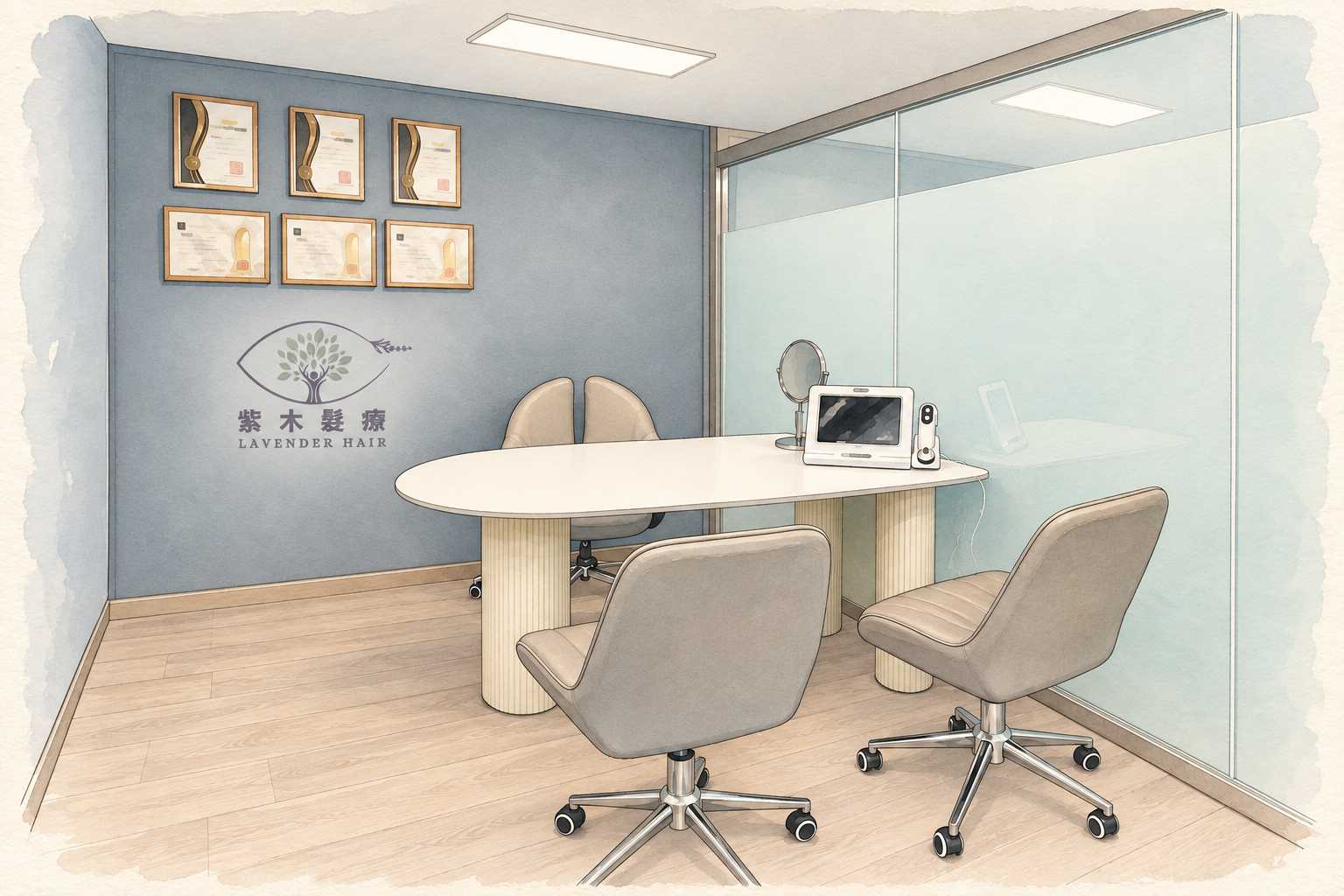
We use 50–200× magnification to observe the scalp surface, hair and follicle openings. Your practitioner explains the images in person.
Discuss current products, cleansing habits and recent changes to identify what deserves attention in everyday care.
We will explain honestly when medical care is needed. You can have only the free check; products or care services can be discussed if you wish.
Tell us how your scalp feels, which products you use and your care habits.
Observe the visible scalp and hair under magnification.
Review the observations and explain everyday care options and service limitations.
You can have only the check. Discuss products or care services if you wish.
It is worth understanding how we explain observations, communicate and define our service boundaries.
Learn about the Lavender Hair team, care qualifications and professional commitments before deciding whether we suit your needs.
Meet the Lavender Hair team →Visit Google or Facebook to read customers' original comments, dates and full experiences, and find both branches.
Public reviews and branch locations →Hair alone cannot tell you this. Chinese medicine concepts of liver, kidneys, qi and blood have their own theoretical background. Actual organ disease needs medical assessment.
No. Chinese medicine patterns require a practitioner's assessment. Observing scalp appearance cannot replace a consultation.
Tell your treating practitioner which products and services you use. After scalp needling, while using topical medicines, or if you have skin discomfort, follow their advice on cleansing and care.
There is insufficient direct comparative evidence for this claim. Everyday care and medical treatment serve different purposes. Understand the cause and your needs before choosing.
Yes. You can have the free scalp check and hear the explanation. If you want to explore products or care services, we can discuss them afterwards.
The free scalp check usually takes under 60 minutes. Bring the names or packaging photos of your current shampoo or serum. Book your preferred branch through WhatsApp first.
If you would like help reviewing everyday care questions, book a free scalp check. Look, listen, then decide your next step.
Usually under 60 minutes · A check-only visit is welcome
See a doctor first for sudden heavy or patchy hair loss, marked scalp redness or swelling, pain, pus or oozing. Lavender Hair offers scalp-surface observation and everyday care advice. Ask a doctor, pharmacist or your Chinese medicine practitioner about diagnosis and medication.