Choosing hair-loss medication? Start with what matters most to you.
Already using treatment, thinking about starting, or simply researching? Understand how medicines work, their limitations and risks, then discuss them with a doctor or pharmacist.
Compiled by Lavender Hair · Updated: 6 October 2026
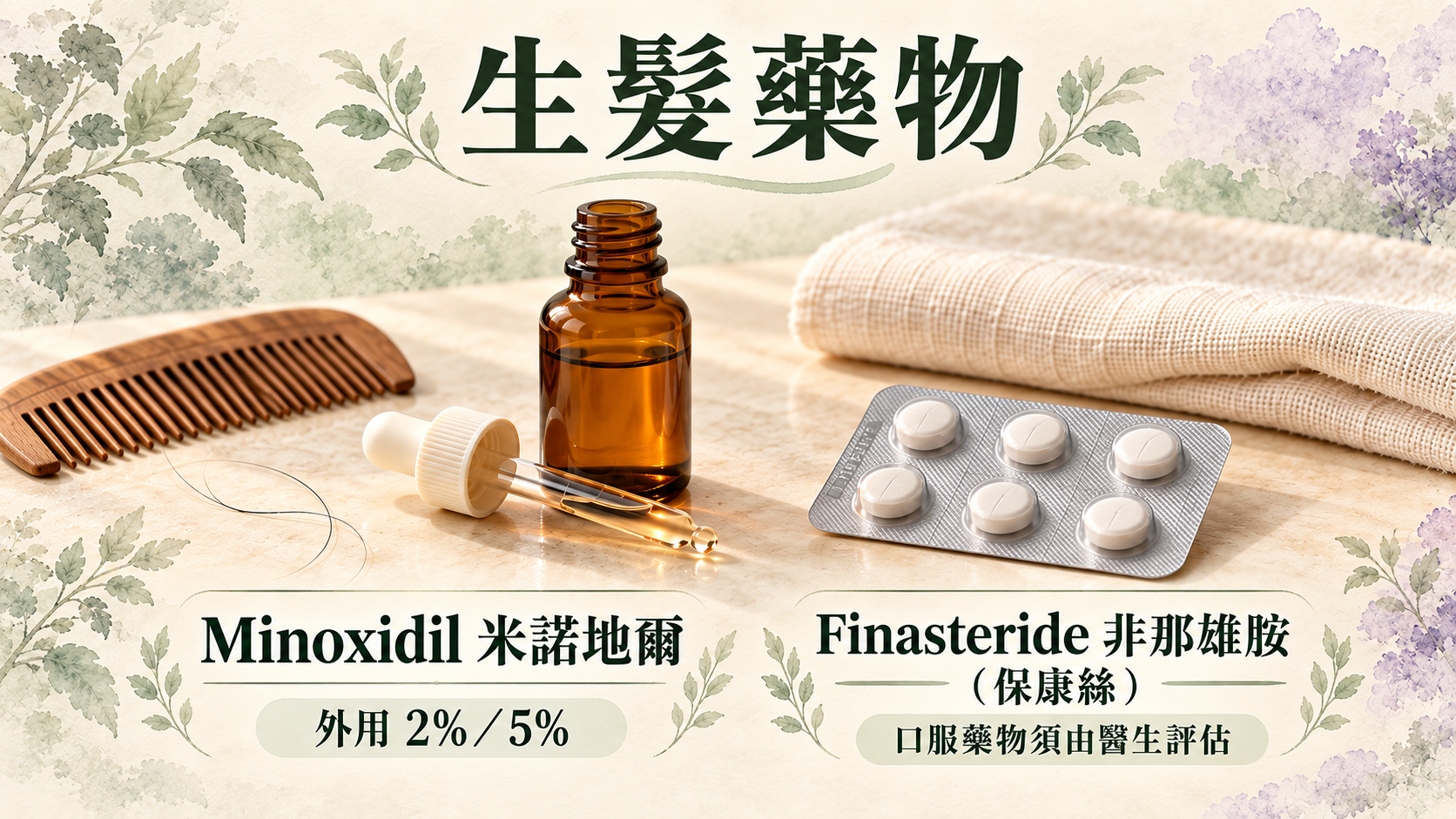
Illustration of common topical and oral hair-loss medicines.
Suitability, expected benefits and risks depend on the medicine and your individual circumstances.
Medicated shampoo
Specific ingredients address particular scalp problems. Dandruff control does not automatically mean hair regrowth.
Everyday scalp care
Focuses on cleansing and care habits. It cannot replace a diagnosis or medical treatment for hair loss.
Contents · Jump to a topic
Does hair loss always need medication? Understand the cause first
Not necessarily. Shedding after childbirth, illness or rapid weight loss may improve as the body recovers. Hereditary hair loss, alopecia areata and inflammation-related hair loss require different approaches. A doctor will consider your medical history and scalp condition to decide whether blood tests or other investigations are needed.[2]
1. Topical minoxidil
Role and benefits: Used for male and female pattern hair loss, it can help some people slow hair loss and improve density. Common forms include solutions and foams; instructions vary by strength, product and user. In Hong Kong, topical preparations containing no more than 5% minoxidil must be sold in a pharmacy under a pharmacist's supervision.[1]
Limitations and risks: May cause dryness, redness, itching or flaking and should not be applied to broken skin. Shedding may temporarily increase in the first few weeks. Ask a healthcare professional if it continues to worsen or causes discomfort. Treatment usually takes several months; some people need 6–12 months to see improvement. Benefits usually fade gradually after stopping.[3]
Do not self-start treatment while pregnant, trying to conceive or breastfeeding. If you have cardiovascular problems or take blood-pressure medication, consult a doctor or pharmacist before starting.[4]
2. Oral minoxidil
Role: Originally used to treat high blood pressure, it is also prescribed at low doses for some hair-loss cases. UK NHS guidance describes use for hair loss as off-label. This means it falls outside the medicine's locally approved indications, so a doctor needs to explain the evidence, risks and monitoring. The safety of topical treatment cannot simply be assumed for oral treatment.[5]
Risks and monitoring: Possible effects include increased facial or body hair, swelling, palpitations, low blood pressure and dizziness. A doctor may monitor blood pressure, pulse and existing health conditions. Seek immediate medical care for chest pain, difficulty breathing or fainting. Never swallow a topical hair-growth product or buy blood-pressure medicine to try for hair growth yourself.[4]
3. Finasteride
Role and benefits: Reduces production of dihydrotestosterone (DHT). Used for male pattern hair loss, it can slow follicle miniaturisation and improve hair density in some people. Oral finasteride is prescription-only in Hong Kong. Results usually take months to assess, and maintaining benefits often requires ongoing treatment.[1][2]
Main risks: Reduced libido, erection or ejaculation problems, and psychiatric side effects including depression and suicidal thoughts. Some sexual problems may persist after stopping. Tell your doctor about relevant medical history before starting. Updated UK MHRA guidance from May 2026 advises people taking 1 mg finasteride for hair loss to stop and contact their doctor promptly if depression or suicidal thoughts develop. This is safety advice for a specific adverse reaction, not a recommendation that everyone stop treatment.[6]
People who are pregnant or may become pregnant should not use it and should avoid handling crushed or broken tablets. Do not divide tablets intended for prostate conditions into a self-selected hair-loss dose.[1][8]
4. Dutasteride
Role: Also reduces DHT and is prescribed by some doctors for assessed cases of male pattern hair loss. Its approved UK indication is benign prostatic enlargement; use for hair loss is outside that indication. Greater DHT reduction does not mean better results or greater suitability for everyone. Check local approved information for the indications of individual Hong Kong products.[6][3]
Risks: Possible sexual and breast-related side effects. A 2026 Canadian safety review found limited evidence linking dutasteride with suicidal thoughts but strengthened warnings as a precaution. This should not be described as proof of the same level of risk as finasteride. Report changes in mood or sexual function promptly to your doctor. Pregnant people should avoid handling leaking capsules.[7][9]
5. Spironolactone
Role: Has anti-androgen effects and may be considered by a doctor for some cases of female pattern hair loss. UK information describes this as off-label use. Results develop slowly and usually need several months to assess; it does not work for everyone.[10]
Main risks: Breast tenderness, irregular periods, dizziness, low blood pressure and raised blood potassium. Kidney disease and certain other medicines increase risk. A doctor may check potassium and kidney function. Do not use it for this purpose while pregnant or trying to conceive; discuss contraception and breastfeeding beforehand.[10]
Medicated shampoo: does dandruff control mean hair regrowth?
Choose medicated or anti-dandruff shampoos by their ingredients and intended use. Ketoconazole is an antifungal ingredient used to control dandruff; other products may contain salicylic acid or coal tar. These are dandruff-management options. Their anti-dandruff use alone does not establish that they reverse hereditary hair loss, regenerate follicles or replace hair-loss medication.[15][16][17]
Topical products can also cause irritation or allergy, including dryness, burning, redness or itching. Follow the specific label or healthcare advice for frequency, contact time and age suitability. More frequent use or longer contact is not necessarily more effective and may irritate the scalp. Avoid eye contact. Seek immediate medical care for serious reactions such as swelling of the face or lips or difficulty breathing.[17][18][19]
Persistent dandruff, marked redness or swelling, pain, or accompanying hair loss should be assessed by a doctor or pharmacist. When buying in Hong Kong, check the specific product's registration and sales requirements. Overseas non-prescription classifications do not automatically apply in Hong Kong. Packaging terms such as “medicated” or “anti-hair loss” alone do not establish effectiveness.[16][12]
How can everyday scalp care help?
Lavender Hair can review your current products, cleansing habits and scalp comfort, observe the scalp surface and hair, and discuss everyday care. If you are receiving treatment, bring your healthcare instructions and product information so care can be coordinated.
Already using medication? Start with these questions
Keep to your existing medical follow-up plan. Discuss dose changes, switching or stopping with your prescriber first. If a serious reaction listed in the medicine's warnings occurs, act immediately according to the safety guidance.
How long have you used it? Have you attended your scheduled review?
Have you developed new or persistent symptoms? Note when they started and ask a healthcare professional.
Have you recently changed shampoo, serum or other products? Bring their names to discuss.
Work through your next step, one at a time
Tried different approaches without the changes you hoped for?
Repeated attempts without the improvement you hoped for can be tiring. You do not have to decide every next step at once. Start by listing what you tried, for how long, how it felt and what changed. Discuss your existing treatment with your doctor, and review everyday care one step at a time.
If you would like to speak with Lavender Hair, we can listen to your previous care experiences, observe the visible scalp surface and explain possible adjustments to your routine. We will also make clear when medical assessment is needed.
Want to understand everyday scalp care? Start with a free observation.
If you want to review washing, product combinations and care habits, we can look together and talk it through. A free scalp check usually takes under 60 minutes. You may have the check only, hear the explanation, then decide.
Free
Usually under 60 minutes
Assessment Only Is Welcome
Two Tsim Sha Tsui branches
Illustration of the scalp observation process
01
See the visible condition together
We use 50–200× magnification to observe the scalp surface, hair and follicle openings. Your practitioner explains the images in person.
02
Understand your care routine
Discuss current products, cleansing habits and recent changes to identify what deserves attention in everyday care.
03
Understand the service boundaries
We will explain honestly when medical care is needed. You can have only the free check; products or care services can be discussed if you wish.
Let's Talk
Tell us how your scalp feels, which products you use and your care habits.
Look together
Observe the visible scalp and hair under magnification.
Hear the explanation
Review the observations and explain everyday care options and service limitations.
You decide
You can have only the check. Discuss products or care services if you wish.
Usually several months. Some people need 6–12 months to see improvement with topical minoxidil. Other medicines should be assessed at the review times set by your doctor. Take photographs with consistent lighting, angles and hairstyle rather than judging only by daily shedding.
Will hair loss return after stopping?
Male and female pattern hair loss often need long-term management. Benefits maintained by minoxidil or finasteride usually fade after stopping, and hair loss may progress again. This is not drug addiction and does not prove that stopping makes the original condition worse. Discuss stopping or changing treatment with your prescriber first. For serious adverse reactions listed in the warnings, follow the safety guidance immediately.
Is topical finasteride guaranteed to have no systemic side effects?
No. The US FDA warns that compounded topical finasteride can be absorbed through the skin and accidentally transferred to others, with particular concern about pregnancy exposure. Approvals differ by formulation and region. Topical does not mean risk-free.
Can biotin, iron supplements or hair-growth shampoo replace medication?
There is no universal answer. Supplements should address a confirmed deficiency. Extra supplementation without a deficiency may not help, and excessive amounts can be harmful. Judge care products by their ingredients and evidence, not by a hair-growth claim on the label.
What should I check when buying hair-loss medication in Hong Kong?
Check the medicine name, formulation, Hong Kong registration and sales requirements. Registration, approval for a particular indication and suitability for you are three different things. Ask a registered doctor or pharmacist; do not combine medicines or increase doses based only on online advertising.
Can hair-loss medicines cause palpitations or affect sexual function?
The medicine matters. Oral minoxidil requires attention to palpitations, low blood pressure and swelling; finasteride and dutasteride require particular discussion of sexual and mood-related risks. In first-year trials in the US finasteride 1 mg label, reduced libido occurred in 1.8% (placebo 1.3%), erectile dysfunction in 1.3% (0.7%), and ejaculation problems in 1.2% (0.7%). One person may have several symptoms, so percentages cannot be added. Trials also cannot fully estimate the risk of symptoms persisting after stopping. These figures cannot simply be applied to other medicines, doses or populations.
Can fertility be affected? Are men trying to conceive and pregnant women the same issue?
These are different issues. Reduced semen quality or infertility has been reported in some men taking finasteride. The NHS describes this as uncommon and says semen quality usually recovers after stopping. Discuss plans for children or difficulty conceiving with your doctor. Dutasteride labelling also notes possible changes in semen characteristics, with uncertain effects on an individual's fertility. Fetal risks from pregnancy exposure to particular medicines require separate assessment. It is inaccurate to say that a man taking medication always causes birth defects. The NHS says finasteride levels in semen are very low and harm to a pregnant person or fetus is very unlikely.
Does the saying “all medicines have risks” mean medication should be avoided?
It is a reminder to understand risks, not proof that no medicine is worth using. Whether to treat depends on the cause of hair loss, expected benefits, personal risks and your preferences. A doctor can explain the considerations of treatment and no treatment so you can make an informed choice. Do not stop, increase or change treatment based only on a list of side effects.
Can medicated anti-dandruff shampoo replace minoxidil?
Dandruff control does not make them interchangeable. A medicated shampoo's role depends on its ingredients and approved uses; minoxidil is used for some cases of male and female pattern hair loss. Dandruff and thinning may need separate assessment. Do not replace an existing treatment with shampoo yourself.
Questions before your visit
Can I have only the free check without buying products or care services?
Yes. You can have the free scalp check and hear the explanation. If you want to explore products or care services, we can discuss them afterwards.
Can I visit while taking medication or seeing a Chinese medicine practitioner?
You can ask about everyday hair care. If you are receiving treatment, have recently had scalp needling, or have wounds or discomfort, ask your treating practitioner about suitable cleansing and care first. An in-store observation does not replace medical follow-up.
How much time should I allow, and what should I bring?
The free scalp check usually takes under 60 minutes. Bring the names or packaging photos of your current shampoo or serum. Book your preferred branch through WhatsApp first.
Understand, then decide
There is no need to rush into a care service. Understand your options first.
If you would like help reviewing everyday care questions, book a free scalp check. Look, listen, then decide your next step.
Usually under 60 minutes · A check-only visit is welcome
What should I do after reading?
See a doctor first for sudden heavy or patchy hair loss, marked scalp redness or swelling, pain, pus or oozing. Lavender Hair offers scalp-surface observation and everyday care advice. Ask a doctor or pharmacist about diagnosis and medication.